Generative Engine Optimization (GEO) for Healthcare Practices:
What It Is & How to Do It
Key Points
- Generative engine optimization is the practice of tailoring website content and metadata so AI-powered search platforms can easily trust and cite your practice as an authoritative source, helping you stay visible as patient search behavior continues to evolve.
- Rather than replacing traditional SEO, implementing GEO builds a well-rounded digital marketing strategy for healthcare practices that combines foundational SEO best practices with GEO-specific tactics such as schema markup, semantic relevance, and conversational language optimized for AI engines.
- AI engines favor well-organized, expertise-driven content that directly answers patient questions. Keyword-stuffed or poorly structured content is unlikely to be surfaced or cited.
- Medical, dental, and aesthetic practices should treat GEO as a continuous strategy rather than a one-time effort, regularly auditing content and adapting to algorithm changes while ensuring that AI-assisted content remains HIPAA-compliant and free of patient privacy violations.
In the fast-evolving digital landscape, healthcare practices must continually adapt to new technologies and trends in order to remain competitive. Among these trends, generative engine optimization (GEO) has emerged as an innovative strategy to enhance visibility, attract more patients, and boost efficiency. In this comprehensive guide, we will explore what GEO is, how it compares to SEO, how it can benefit healthcare practices, and practical steps on how to implement it successfully.
Get Your Complimentary Evaluation Today
At Rosemont Media, we aim to leverage the strengths of both technological efficiency and human expertise. In the past, we’ve written about how AI content impacts the future of SEO, emphasizing the need for continued human oversight. AI-driven tools can analyze vast amounts of data quickly, identifying keywords, trends, and local search patterns that help boost a healthcare practice’s visibility. Meanwhile, human experts refine these insights, tailoring content strategies to resonate with the target audience, ensuring high-quality, engaging content. This blend of automated efficiency and human creativity enhances search rankings, improves website traffic, and drives more qualified leads to our medical and dental clients.
- Intro to GEO
- SEO vs. GEO
- GEO Benefits
- How Do I Use GEO?
- Multimedia Content for GEO
- GEO Regulations
- Common GEO Mistakes
- Contact RM for GEO Guidance
- Generative Engine Optimization FAQs
What is Generative Engine Optimization (GEO)?
Generative engine optimization (GEO) is an emerging digital marketing approach that focuses on tailoring content for generative AI platforms. It involves creating highly optimized, unique content based on keywords, search trends, and user behavior to be easily understandable by both humans and AI.
What specifically sets GEO apart is its emphasis on AI-friendly content. Google and other search platforms are integrating AI tools more and more to enhance user experience. This shift is accompanied by the rise of a new class of generative AI platforms, such as ChatGPT, Perplexity, Gemini, Claude, and Copilot. These produce AI-generated answers to user queries based on web sources, as opposed to providing a traditional list of page links. At the same time, traditional search engine platforms are continuously integrating AI features in other ways, making it increasingly important to ensure your content is optimized for both human users and algorithms.
The large language model (LLM) algorithms that underlie generative AI tools are designed to intake and synthesize content from multiple sources in order to produce a clear, concise answer to a user query. Google’s AI Overviews (this was previously referred to as the “Search Generative Experience” or “SGE”) are a frequently seen example of this. While human users should ultimately remain the primary audience for all content, strategies involving GEO for plastic surgeons, GEO for dentists, and generative engine optimization for other types of medical practices can help optimize your copy to give it the best chance of showing up in both traditional search engine results as well as AI-generated snippets and answers.
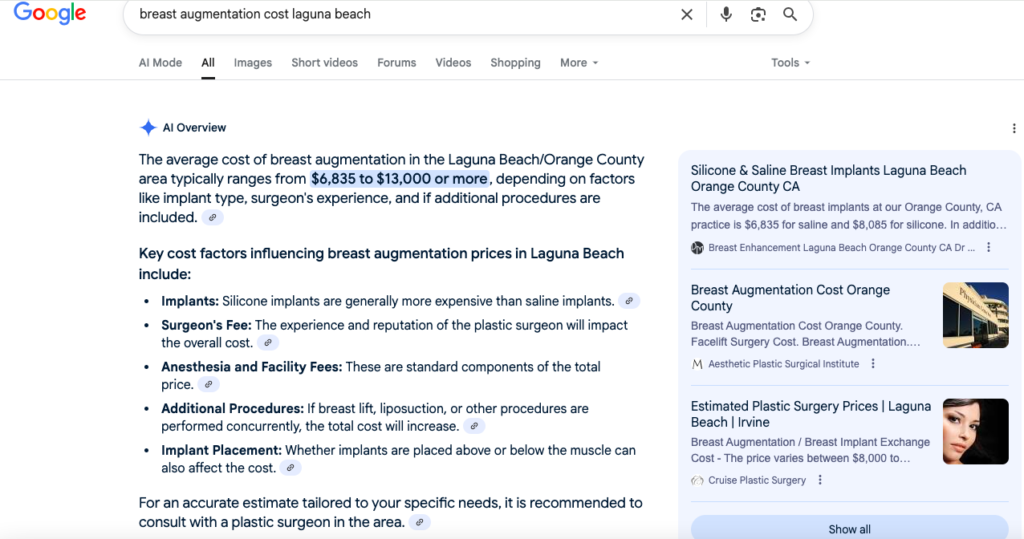
AI Overview Result for a Plastic Surgery Practice
Here is a visual example of an AI Overview result featuring the answer to a common search term about pricing for a popular procedure in a specific geographic area. The website resource list on the right side displays a link to Aesthetic Plastic Surgical Institute, a client of Rosemont Media:
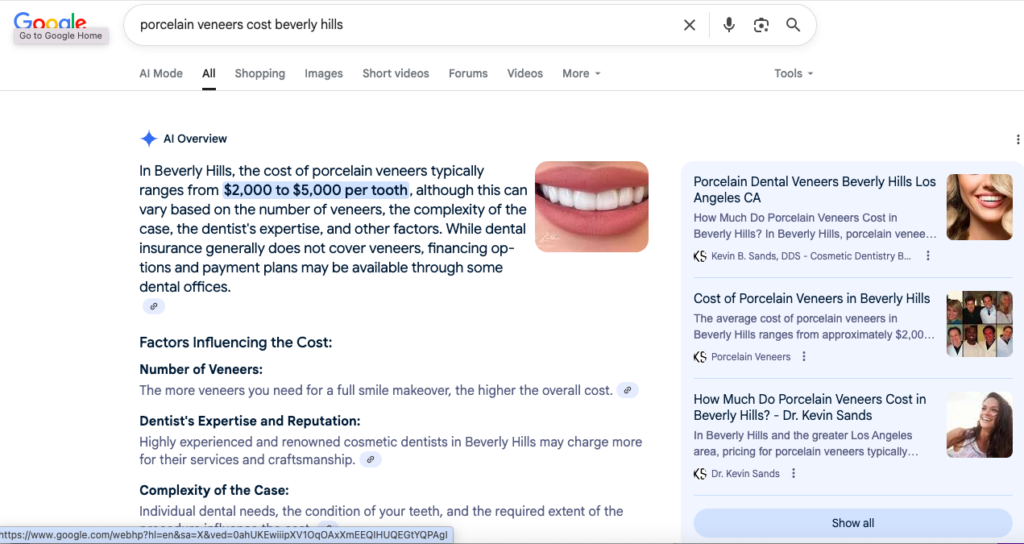
AI Overview Result for a Dental Practice
In this example featuring results for our client, the term “porcelain veneers cost beverly hills” was searched. Again, the AI Overview result features a cost range followed by a summation of factors that can affect the price. On the right-hand side is a list of resources and links used to gather that information. The website for Dr. Kevin Sands, appears in the top three slots:
AI Overview Result for a Medical Practice
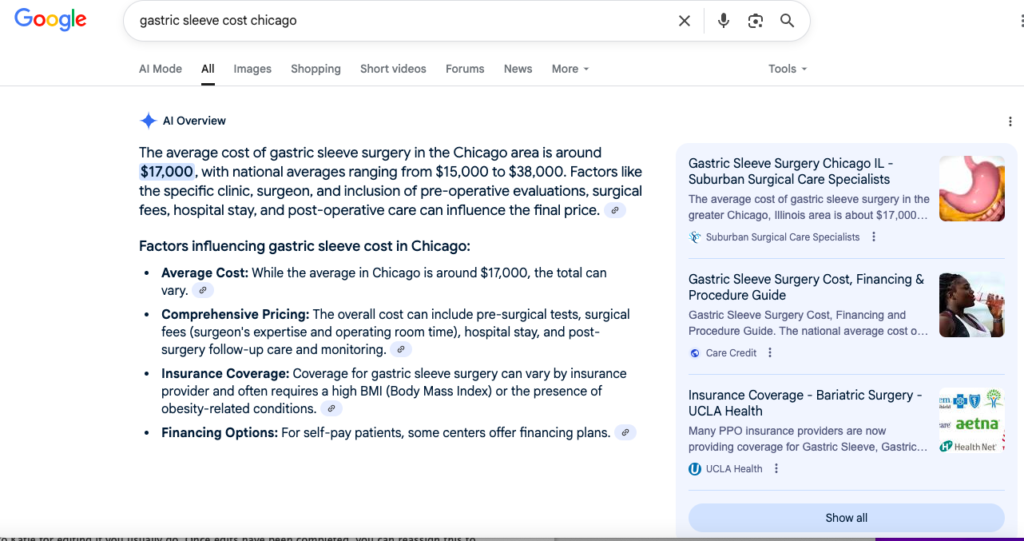
Finally, here is an example of a popular search term for a medical practice. The AI Overview result features another Rosemont Media client, Suburban Surgical Care Specialists—which is a practice offering a variety of bariatric surgery procedures—in the top slot on the resource list:
SEO vs. GEO
While traditional SEO for plastic surgeons and dental SEO focus on content creation, keyword placement, and link building for the purposes of organic search engine results page (SERP) rankings, GEO is designed to optimize for generative engines and other AI integrations. It takes into account factors like search intent, user experience, and semantic relevance to create content that is not only optimized for algorithmic tools but also resonates with human readers.
That said, GEO is not a replacement for traditional SEO. Indeed, the bedrock of an effective digital marketing strategy in an increasingly AI-reliant era needs a blend of SEO and GEO best practices.
Both SEO and GEO require a fundamental understanding of audience, services, and business goals. The healthcare marketing experts at Rosemont Media are happy to assist you in creating a comprehensive strategy that is tailored to your practice’s specific needs.
Benefits of GEO for Medical and Dental Practices
1. Optimizing for AI-Driven Generative Engines
Generative search engines are not just providing links—they are pulling answers from various sources, making it crucial for businesses to ensure their content is among the material that AI considers. A good GEO strategy helps businesses craft copy that aligns with the way AI models interpret and synthesize content.
- Structured Content for AI Consumption: GEO ensures that content is well-structured, using proper headings, metadata, and semantic tagging. This allows generative AI tools to more easily parse and utilize the content, increasing your practice’s visibility with users.
- Better Contextual Understanding: AI models, especially those used in generative search, prioritize natural language understanding. GEO’s focus on creating contextually relevant content helps AI-driven search engines better comprehend and match the intent behind user queries, enhancing the quality of its responses.
2. Increased Visibility in AI-Powered SERPs
With an increasing number of AI tools being integrated into search engines, optimizing content to be “AI-friendly” has become an important part of ensuring your practice is as visible as possible to prospective patients.
- Organic Rankings: In addition to enhancing the likelihood of being cited in AI-generated content, AI-friendly content is also easier for traditional search engine algorithms to understand and rank, which can increase visibility in organic search results.
- Featured Snippets and Answer Boxes: GEO’s emphasis on concise, structured, and high-quality content helps businesses appear in AI-generated answers, such as Google’s AI Overviews, as well as featured snippets and People Also Ask (PAA) boxes, which are prime real estate in search results.
- Voice Search Optimization/Conversational Interface Optimization: As voice search grows in popularity, GEO content is optimized for voice search algorithms, which prioritize conversational, clear, and intent-driven responses. GEO helps generate content that is easily interpreted and read aloud by voice assistants like Siri, Alexa, and Google Assistant.
3. Improved User Engagement through Conversational Search
Studies show that users respond best to more conversational and human-like responses to queries. GEO may involve leveraging AI to generate content that not only ranks well but also engages users by mimicking a natural conversational tone.
- Tailored Responses: AI tools can generate responses that align with common conversational search patterns, such as answering FAQs, providing concise explanations, or offering detailed insights, based on user intent. This improves the likelihood that AI-driven search engines will feature your content in direct, synthesized answers.
4. Enhanced Local Search Performance
For businesses with a local presence, like healthcare practices or brick-and-mortar stores, AI-driven search engines are critical for showing up in local search results. GEO helps optimize content for local SEO, ensuring your business is visible in the Google local pack, maps, Knowledge Panels, and AI-driven queries related to your region.
- Localized Content: GEO can generate content that includes geographic-specific keywords, ensuring that businesses rank well for searches that include location-based intent. AI search models prioritize such content for local queries, driving more foot traffic and local engagement.
- Google Business Profile Optimization: With the increasing integration of Google Business Profiles into AI-powered search results, AI tools can help your practice maintain an optimized profile by generating consistent, relevant content for local listings, reviews, and business updates. In fact, optimizing your GBP has taken on new importance. While features like hours, photos, and updates are still useful, AI engines now place greater emphasis on user-generated content and structured Q&A data. Encouraging patients to leave detailed, keyword-rich reviews can help signal trust and relevance to Google’s AI systems. Additionally, populating your profile’s Q&A section with accurate, informative responses allows your content to potentially be featured in AI-generated answers. Pairing this with structured data (schema markup) on your website helps search engines better understand and connect your online presence across platforms. This holistic approach can increase your chances of appearing not only in local map results, but also in the AI-generated summaries that are becoming more prominent across Google’s search experience.
How to Incorporate GEO into Your Digital Marketing Strategy
1. Leverage AI Tools
To implement GEO effectively, a marketing strategy should ideally incorporate AI-powered tools designed for content optimization and generation while still ensuring human oversight. Partnering with a marketing agency that specializes in healthcare GEO—like Rosemont Media—can also help tailor your approach to meet your specific business goals.
2. Develop a GEO Content Strategy
A GEO-driven content strategy begins with a clear understanding of your patients’ needs, the types of services you offer, and the competitive landscape in your area. Start by identifying the most relevant keywords and search phrases for your practice, such as “pediatric dentistry,” “breast implant removal,” or “dental implants in [your location].”
Once you have your core keywords, GEO tools can begin generating content that caters to these terms. For instance, you can create blog posts that cover common issues, step-by-step guides on various medical or dental procedures, and engaging educational videos on oral health.
Make sure that your GEO content strategy extends to every area of your online presence, including:
- Service Pages: Ensure each service page on your website is populated with optimized content that matches user intent and answers common patient questions.
- Blog Posts: Consistently publish GEO-optimized blog posts addressing common medical or dental concerns, new treatments, or patient success stories.
- Social Media Posts: Share snippets of your GEO content on social media, tailored for platforms like Facebook, Instagram, and TikTok, to reach a wider audience.
3. Optimize for Local Search
For healthcare practices, local search optimization is essential. GEO helps you create localized content that targets patients in your geographic area. Using GEO to create content that includes location-based keywords (e.g., “family dentist in Brooklyn” or “plastic surgeon in Seattle”) can improve your chances of appearing in the “Local Pack” on Google—a set of business listings that show up in response to local queries.
Additionally, GEO can assist with optimizing your Google Business Profile and ensuring your practice appears in local map results. This makes your practice easy to find when patients are searching for nearby services.
4. Monitor and Adapt in Real Time
Search algorithms are increasingly powered by AI and machine learning. As these algorithms evolve, the criteria for ranking content also change. Regularly monitor your practice’s online performance using tools like Google Analytics or Search Console to track keyword rankings, website traffic, and patient inquiries.
By analyzing this data, you can make informed decisions about what content to prioritize and where to make improvements. Analytics tools often provide performance insights, helping you identify which content is driving the most conversions and which areas may need further optimization.
Embracing Multimodal Content for Generative Visibility
As generative engines evolve, so too do the types of content they prioritize. In 2025, large language models are increasingly capable of understanding and referencing multimodal inputs—content that includes not just text, but also images, videos, audio, and visual data annotated with meaningful metadata. For healthcare practices, this trend offers a new opportunity: optimizing multimedia assets for AI discovery.
Visual Elements with Contextual Clarity
Search engines now extract context from visuals by reading file names, alt text, and surrounding copy. Including clear, keyword-relevant descriptions for before-and-after photos, procedural images, infographics, and even video thumbnails can help AI models interpret and index your media more effectively. For example, an image titled “dental-implant-recovery-day-1.jpg” paired with a concise alt text like “Day 1 after dental implant placement by Dr. Smith in San Diego” is more likely to be featured in image-rich AI-generated content.
Video Content Optimization
Short-form and educational videos are increasingly being referenced in generative answers, especially when paired with transcripts, captions, or embedded schema markup. Posting procedure explainers or provider Q&As to platforms like YouTube, then embedding those videos on your website with structured data and GEO-friendly language, can enhance your chances of being cited by AI engines.
Cross-Platform Consistency
Ensure your visual and video content is consistent across platforms such as your Google Business Profile, social media, and your website. AI engines seek out cohesive, authoritative sources. When the same patient education video or visual explainer appears in multiple high-trust locations with unified branding and messaging, it increases both discoverability and perceived reliability.
By embracing multimodal optimization, your practice can engage more patients visually, strengthen your presence across generative search results, and build deeper trust through rich, accessible content experiences.
Navigating Regulatory Considerations in AI-Powered Content
As the healthcare industry embraces AI for marketing, it’s crucial to remain vigilant about compliance with regulatory standards. In 2025, several states are reviewing guidelines related to the ethical use of AI, especially when it comes to patient communications and healthcare advertising.
A couple of important things to always keep in mind:
- Protect Patient Privacy: AI-generated content should never include real patient names, medical histories, or identifying details unless proper written consent has been secured. Even anonymized data should be handled cautiously under HIPAA guidelines.
- Avoid Medical Misrepresentation: Generative tools can sometimes produce exaggerated claims or medically inaccurate suggestions. It’s essential that all content—whether human- or AI-written—is reviewed for factual accuracy and adheres to medical advertising standards.
Partnering with an agency that understands both digital marketing and healthcare compliance, such as Rosemont Media, can help your practice stay on the right side of evolving regulations while maximizing the benefits of AI integration.
Common GEO Mistakes Healthcare Practices Make
As GEO becomes increasingly necessary to stay visible and authoritative in a competitive market, using the right approach is paramount. A savvy website strategy is essential, and avoiding common mistakes as you incorporate AI search optimization into your online marketing plan can help you expedite the process of seeing real practice growth. Common GEO pitfalls typically include:
- Treating GEO as a Replacement for SEO: One of the most frequent misconceptions involves the existence of GEO making traditional SEO obsolete. In reality, these two strategies work in conjunction with each other. A practice that abandons foundational SEO efforts, such as building quality backlinks, optimizing page speed, and maintaining a technically sound website, in favor of GEO alone will likely see their overall search visibility suffer. Medical practices should think of GEO as an additional layer on top of a strong SEO foundation, not a substitute for it.
- Producing Generic, Low-Authority Content: Generative search engines are designed to prioritize content that demonstrates expertise, experience, authoritativeness, and trustworthiness. These principles are already closely aligned with Google’s E-E-A-T guidelines, which have long been an influencing factor in determining organic SEO rankings. Generic or completely AI-generated blog posts are unlikely to be cited as authoritative sources. Instead, content should reflect the genuine expertise of your providers, retain human oversight, reference your practice’s specific experience, and offer unique insights that a patient can’t just find anywhere online.
- Ignoring Search Intent: Generative AI platforms can be exceptionally good at understanding what a user actually wants — not just the words they type into a search bar. Semantic relevance is a large driver of AI search visibility, so healthcare practices that stuff content with keywords without addressing the underlying question or concern behind a search query will struggle to be cited by AI engines. Content that directly and conversationally answers the real question is far more likely to be surfaced in an AI-generated response.
- Neglecting Content Structure: Generative AI models parse and synthesize content much more effectively when it is clearly organized. Walls of unbroken text, missing headers, and poorly labeled metadata all make it harder for AI engines to extract and attribute your content. Using descriptive H2s and H3s, concise bullet points where appropriate, and properly implemented schema markup gives AI tools the structural signals they need to understand and reference your content.
- Overlooking the Google Business Profile: Many healthcare practices put significant effort into their website while leaving their Google Business Profile (GBP) incomplete or outdated. Sparse reviews, unanswered questions, and outdated information can cause your practice to be passed over in favor of local competitors with more robust, well-maintained profiles.
- Lack of Ongoing Strategy: GEO is not a one-and-done project. Generative AI platforms are continuously updated, and the criteria by which they evaluate and surface content evolve alongside them. Practices that develop a GEO strategy and then fail to monitor performance, refresh content, or adapt to algorithm changes will find their visibility eroding over time. Regular content audits, performance tracking, and a willingness to iterate are essential components of any sustainable GEO strategy.
Like all strategies, adapting your practice to Generative Engine Optimization is a process of constant refinement. Steering clear of these mistakes will help your practice become better positioned to earn lasting visibility across both traditional and AI-powered searches.
Elevating Your Online Presence with GEO
At Rosemont Media, we understand how important it is to ensure our clients remain on the cutting-edge of innovations in GEO and SEO. By leveraging AI and machine learning, we aim to help medical and dental professionals create highly targeted, optimized content that drives patient engagement, improves search engine rankings, and ultimately leads to higher patient conversions.
With the right tools and strategies in place, your healthcare practice can harness the full potential of GEO to stay competitive in today’s digital age. Implementing GEO can not only enhance your online presence but also position your practice as a leader in your local market—attracting more patients and fostering long-term growth.
Frequently Asked Questions (FAQ) About Medical GEO
Why is Generative Engine Optimization for doctors necessary?
The way patients search for healthcare providers has rapidly changed with the unrolling of AI. Rather than scrolling through a list of search results, a growing number of people are simply turning to AI-powered tools like Google’s AI Overviews, ChatGPT, Claude, and Perplexity to get direct answers to their medical questions. These tools pull from a curated set of authoritative sources, increasing the frequency of zero-click searches across the entire web. Since actual website traffic is decreasing with reduced click-through rates, healthcare GEO is integral to “surfacing” in AI results and maintaining digital visibility.
How do AI search engines like ChatGPT and Claude decide what sources to cite?
While each platform uses its own proprietary methodology, most generative engines share a few criteria when evaluating which sources to draw from. They tend to favor content that is well-structured and easy to parse, written in clear and natural language directly addressing common questions. Most AI engines also select from content published on websites with strong domain authority and credible backlink profiles, offering consistent information found across multiple reputable sources. Importantly, content should be reflective of genuine expertise, particularly for medical topics where accuracy and trustworthiness carry extra weight. Keeping your content organized with descriptive headings, schema markup, and thoughtful answers to patients’ questions help designate your practice as a reliable, trustworthy source worth citing.
Does GEO for med spas work differently than doctor GEO?
The foundational principles of GEO apply across all healthcare and aesthetic practices, prioritizing structured content, local optimization, authoritative sourcing, and AI-friendly formatting. That said, med spas face some unique considerations. Since med spas often occupy a space between medical information and lifestyle branding, their content needs to balance clinical credibility with the aspirational, experience-driven tone their audience expects.
Additionally, med spas frequently promote elective aesthetic services that are highly competitive in local search and heavily influenced by trend-driven queries. This means med spa GEO strategies often place a stronger emphasis on seasonal and trend-based content, social proof like detailed patient reviews, and visually rich multimedia assets that AI engines can contextualize through strong alt-text and metadata.
How long does it take to see results from a healthcare GEO strategy?
GEO is a long-term investment and realistic timelines vary depending on factors like your practice’s existing online presence, the competitiveness of your local market, and the consistency of your content output. That said, most practices begin to see early indicators of progress — such as improved organic rankings, increased website traffic, or appearances in AI-generated snippets — within three to six months of implementing a well-structured GEO strategy. More meaningful outcomes, like sustained visibility in AI Overviews and measurable increases in patient inquiries, typically develop over six to twelve months. The practices that see the fastest and most lasting results are those that treat GEO as an ongoing effort rather than a one-time fix, regularly refreshing content, monitoring performance, and adapting to changes in how AI platforms evaluate sources.
Contact the digital marketing experts at Rosemont Media today to learn more about our GEO services and unlock the power of AI-driven optimization.
Editor’s note: The original version of this post was published on 9/10/2024.